Cloud Engineering Roadmap Accelerated by the Power of AI at EPAM
Cloud Engineering Roadmap Accelerated by the Power of AI at EPAM
CATEGORY
Blog, Career Tips
Beth Neil
Principal Marketing Specialist
DATE
Dec 5, 2025
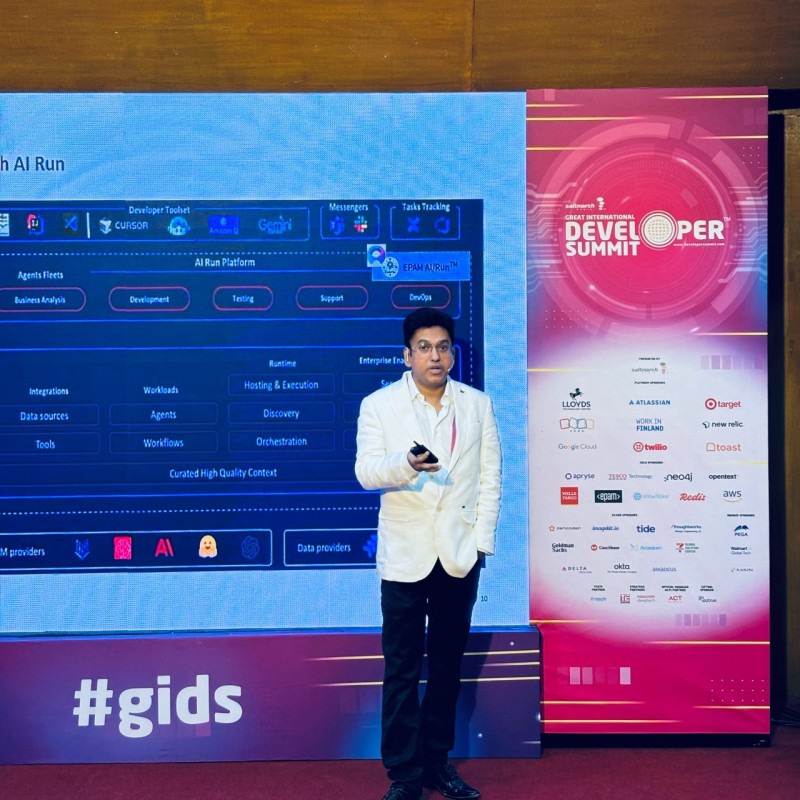 When faced with the new, unfamiliar or potentially impossible, Suvankar Chakraborty, Systems Architect II at EPAM, follows his instincts (and years of engineering experience) to solve problems and stay ahead of the curve.
With the onset of the cloud era, Suvankar quickly expanded his skillset, recognizing agility and scalability as the new game changers. Today, he leads a DevOps team focused on building GenAI-powered accelerators, all while mentoring and paving the way for future cloud engineers and those interested in working at EPAM.
Based in Bengaluru, India, a city known for its tech innovation, Suvankar is surrounded by the constant opportunity to learn and adapt. With this environment as a backdrop, his approach to this rapidly evolving field and recommended career roadmap feels both natural and attainable.
Journey to the Cloud Inspires a Growth Mindset
“My inspiration for cloud engineering came from seeing how it unified my experience in databases, systems and networking,” said Suvankar. “Early on, I loved making complex environments run smoothly, but one project — to scale an on-premise app during a sudden traffic spike — showed me the limits of hardware.” When his CTO suggested moving to the cloud, Suvankar’s curiosity outweighed his skepticism. Soon he was building scalable, resilient systems by design.
“With my background, I quickly picked up the core concepts and soon I was architecting cloud solutions that scaled globally and recovered instantly,” Suvankar shares. “It was like moving from fixing race cars to designing high-speed trains. That moment of turning technical frustration into a breakthrough got me hooked on cloud.”
A Drive for Innovation Accelerates ‘Simple’ Tasks
Using advanced tech to solve real-world problems motivates Suvankar. “I’m obviously a tech enthusiast,” he says. “So, I’m always exploring how the latest advancements — like GenAI — can be integrated into our solutions.”
His highly innovative mindset drove him to develop a GenAI accelerator that automates the conversion of system design diagrams into Terraform code. Both practical and creative, this solution reduces human error and helps engineers create code directly from architecture diagrams. Suvankar also supported an AWS (Amazon Web Services) FinOps project that integrated natural language processing (NLP) to help the team make the most of the cloud.
His work on projects like these streamlines simple tasks, saves teams hours and ultimately gives cloud engineers and architects more time to create, be curious and test the limits of what’s possible.
Using Creativity to Customize Solutions
Creating code that makes life easier is a rewarding experience, but what Suvankar really enjoys is building modern solutions EPAM clients can count on. He prides himself on listening carefully and partnering with clients to fully understand all angles of their problem to create an efficient, tailored solution.
For example, he recently helped a manufacturing client transition to a Kubernetes-based cloud environment, resolving challenges with downtime and scalability. From minimizing downtime to reducing overall costs, the team was able to expand resource capacity and gain peace of mind.
By combining innovative platforms like GCP, AWS and OCI while focusing on solving individual business challenges, our teams ensure that there is always space for innovation.
“The goal is to match each client to the right technology,” states Suvankar. “That constant challenge keeps my work interesting and exciting.”
Experimenting to Get Ahead of Industry Challenges
One of the primary challenges Suvankar sees cloud engineers facing across the industry is balancing innovation with reliability and security. “It’s a bit like designing a skyscraper,” he explains. “You may want the latest glass and steel on the outside, but you can’t skip the foundation or safety codes.”
At EPAM, introducing a new cloud service or DevOps automation means rigorous architecture reviews and stress tests to ensure that cutting-edge ideas don’t break down once they reach production.
Security is embedded from the very beginning of any project, and automation helps the team enforce security policies and spot errors early. “Identity management, zero-trust access and encryption at rest and in transit are all non-negotiable layers,” states Suvankar. “The fun part of our job is encouraging teams to experiment and break things (in dev, please!) and automate themselves out of boring work; cloud moves fast, but when we automate compliance and resilience checks, we can move even faster.”
Looking to an AI-Driven, Cloud-Native Future
Suvankar predicts even more fusion between GenAI and cloud in the future. “We’re moving beyond ‘cloud as infrastructure,’” Suvankar observes. “We’ll see the cloud as an enabler of real-time insights, automation and predictive capabilities across every industry.” He also predicts that security and governance will evolve, and AI-driven policies will adapt to be able to halt real-time threats. “In short, the future is going to be cloud-native, AI-driven and ready for anything. And so are we,” he concludes.
Join EPAM: a Cloud Engineer Roadmap
The key takeaway from Suvankar’s career journey is that learning is essential. He encourages new Cloud Architects and Engineers to treat learning like a favorite pastime. “Knowing at least one major cloud platform is non-negotiable, but the real magic comes from mastering automation, infrastructure as code and container orchestration,” he advises. “Most importantly, the Cloud Engineers who thrive aren’t afraid to experiment,” says Suvankar. “So, if you love building, fixing and learning, then EPAM is the place where both your inner architect and your sense of adventure are fully engaged.”
If you’re ready for your next adventure building the future of tech, find the perfect role at www.epam.com/careers.