


How We Partnered with The FDA Group to Build the Audit Intelligence Compliance Assistant, Enabling Comprehensive Reviews in Hours Rather Than Weeks
Improving Safety in Life Sciences with Agentic AI
RESULTS
100%
of uploaded documentation reviewed
Same Day
full QMS analysis completed
Instant
reports generated after analysis
EXECUTIVE SUMMARY
We created a way to transform safety audits: Instead of spending a week or more to spot check 10-20% of documentation, AI enables 100% review in hours. In partnership with The FDA Group, EPAM built the Audit Intelligence Compliance Assistant (AICA), powering comprehensive, unbiased reviews of safety documentation for pharmaceuticals and medical devices.
CLIENT
The FDA Group
SERVICES
Strategy, Engineering, Data & Analytics, Artificial Intelligence
INDUSTRY
Life Sciences & Healthcare
Safety First
In the highly regulated world of life sciences, pharmaceuticals and medical devices can only help people if their safety record is proven. The U.S. Food and Drug Administration (FDA) monitors ongoing safety primarily through audits, which are as critical as they are time-consuming.
What if artificial intelligence (AI) could help companies — spanning the biotech, pharma, medical device and diagnostic sectors — prepare for such audits by automating and standardizing the process, while saving time and money?
That’s the question The FDA Group (TFDA), a leading provider of regulatory compliance consulting to the life science industry, posed to EPAM.
Leveraging our DIAL platform, we partnered with TFDA to build a best-in-class product, the Audit Intelligence Compliance Assistant (AICA), which uses the power of agentic AI to cut audit time from days or weeks to hours.
AICA enables comprehensive coverage of 100% of standard operating procedures (SOPs), not the typical 10-20% sampled in a human audit.
STATUS QUO
Preparing for High-Stakes Audits
Across the pharma, biotech and medical device landscape, companies prepare for regular FDA safety audits, in addition to their own internal reviews. They often employ the services of firms like TFDA to conduct “mock” audits. Such audits encompass a review of a company’s standard operating procedures (SOPs) to verify that the devices or pharmaceuticals in question are manufactured in compliance with applicable government regulations.
For example, under good manufacturing practice (GMP), companies are legally required to maintain a quality management system (QMS) that’s compliant with complex government regulations. An auditor (whether a “mock” auditor or an official FDA auditor) reviews the company’s QMS to create a list of observations, which could include non-conformances and potential corrective and preventative actions.
Since even a small biotech firm may be responsible for thousands of SOPS, including those of external vendors, an auditor only has time to “spot check” a subset of the SOPs for compliance. (Companies are responsible for ensuring their suppliers are compliant as well, which prompts more required audits in addition to their internal QMS.) Even “spot checking” is expensive, time consuming and inherently subjective due to varying interpretations of the rules by different human auditors.
The consequences for failing a quality audit are existential, ranging from public disclosure and substantial fines to product recalls or even facility shutdowns.

AGENTIC AI
New Approach to Audits
We partnered with TFDA to bring together its experienced FDA and ISO auditors with our AI developers, business strategists and data scientists to 1) train AICA on real-world QMS documents and 2) validate outputs against known compliance gaps.
Built on EPAM’s DIAL platform, AICA analyzes uploaded QMS documentation against 10 parts of the FDA's Title 21 Code of Federal Regulations:
- Title 21 CFR Part 11 (Electronic Records)
- Title 21 CFR Part 50 (Protection of Human Subjects)
- Title 21 CFR Part 54 (Financial Disclosure by Clinical Investigators)
- Title 21 CFR Part 56 (Institutional Review Boards)
- Title 21 CFR Part 58 (Good Laboratory Practice for Nonclinical Laboratory Studies)
- Title 21 CFR Part 211 (Current Good Manufacturing Practice)
- Title 21 CFR Part 312 (Investigational New Drug Application)
- Title 21 CFR Part 314 (Applications for FDA Approval to Market a New Drug)
- Title 21 CFR Part 320 (Bioavailability and Bioequivalence Requirements)
- Title 21 CFR Part 600 (Biological Products)
The review can be completed in hours rather than weeks, simultaneously maximizing the efficiency of human quality professionals while also enhancing the accuracy, objectivity and thoroughness of audits. The regulations covered continue to expand, with comprehensive medical device regulations such as ISO 13485 in development.
DIAL is EPAM’s open source, service-native platform for enterprise AI. As part of AI/Run™.Tools, it provides the reusable blueprints, governance and integration foundation for AICA, enabling AI capabilities to be applied consistently, improved over time and evolved without locking the client into a single vendor or technology path.
EPAM is also supporting the go-to-market strategy for AICA, including managing the beta testing and customer success programs; supporting new customer acquisition with marketing materials, demos and technical support; and leveraging EPAM’s existing customers and marketing channels to amplify the launch and build market awareness for the tool.
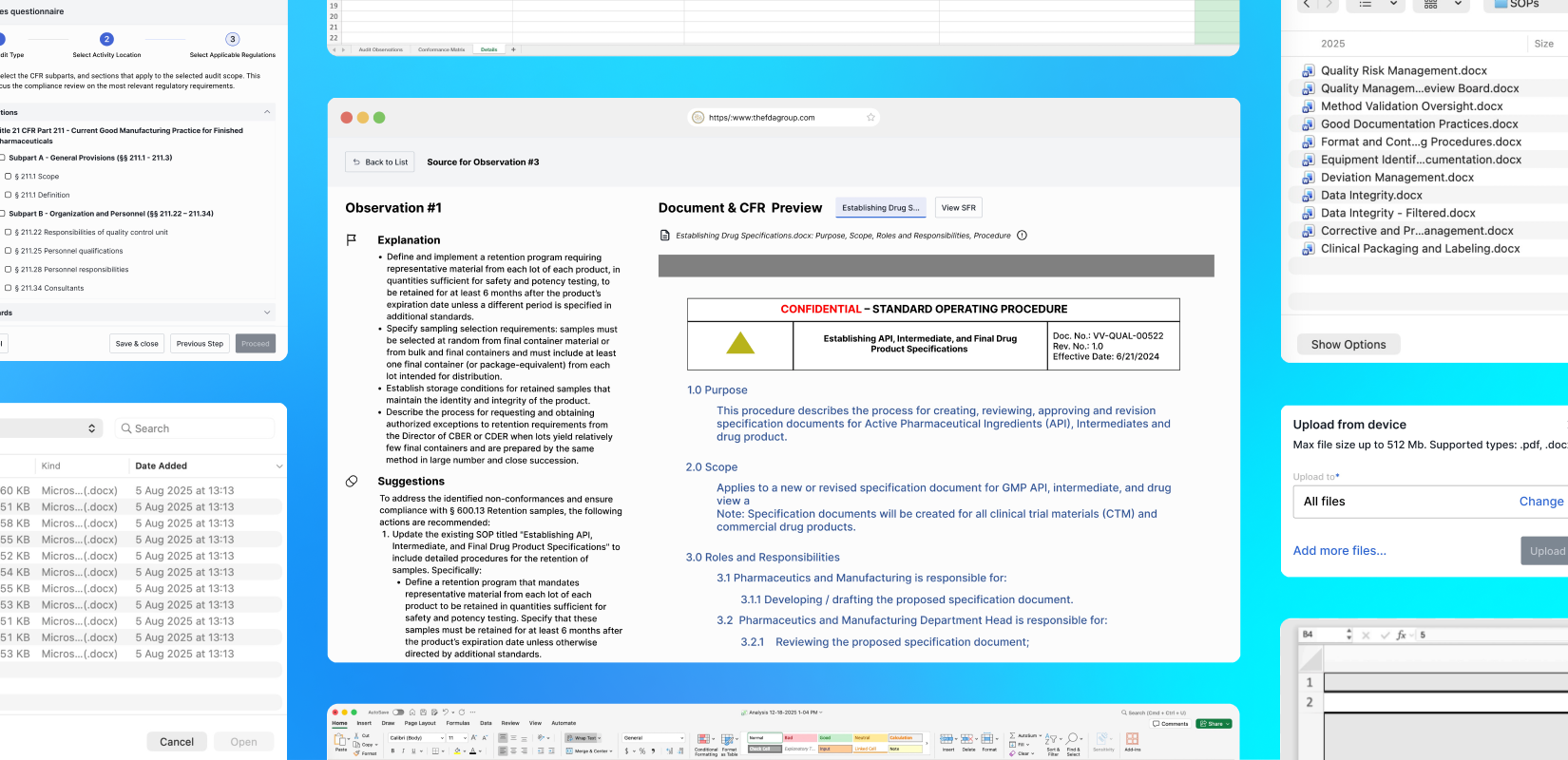
From Upload to Audit-Ready Report in 6 Steps
Rather than sampling documents, companies can upload everything — thousands of pages in minutes.
-
01
Upload Your QMS
Upload policies, procedures, work instructions and forms
-
02
Select Regulations
Choose which CFR parts to audit against
-
03
AI Analysis
AICA compares documents against regulatory requirements
-
04
Human Review
Quality expert reviews AI-generated observations
-
05
Get Reports
Download audit-ready compliance reports
-
06
Take Action
Confidently prioritize the most critical areas of your QMS
Reports include gap analysis, prioritized observations, suggested corrective actions, precise regulatory references, a user-friendly executive dashboard and a full document log for traceability. The time saved means quality professionals are freed up to better focus on strategic quality and compliance issues.
Before & After
AICA is a reimagination of auditing, using agentic AI to provide more comprehensive results faster.
Traditional Audits
Often 1+ week of dedicated auditor time
Usually only 10–20% document coverage
Annual or semi-annual frequency
Days to weeks to generate reports
Sampling methodology
Subjective, auditor-dependent results
AICA Audits
Just hours to process the entire QMS
100% document coverage
Instant report generation on demand
Comprehensive analysis in minutes
Consistent methodology everywhere
Unbiased, repeatable findings

The Future of Life Sciences Safety Auditing
AICA’s journey is just beginning. EPAM and TFDA are actively incorporating new regulations into the tool while also improving the sophistication of the technology and accuracy of the product.
The immediate benefit is improved safety and quality as life sciences professionals can quickly and easily see where the greatest risks are and focus their attention where most needed.
AICA’s scalable, objective approach positions it as a foundational technology for the future of quality and compliance. Ultimately, AICA will make it safer, easier and less expensive to manufacture new drugs and devices, driving better outcomes for companies, regulators and, most importantly, patients.
PARTNER WITH US
Ready to find out how AI can transform your company?